The Ultimate Guide to No-Line Bifocals: See Clearly at Any Age!
The Ultimate Guide to No-Line Bifocals: See Clearly at Any Age!
Tired of the tell-tale line in your glasses or constantly switching pairs to see clearly? This is the core problem solved by modern no line bifocals, which offer a single, seamless solution for presbyopia. We'll guide you through how this advanced lens technology provides natural, uninterrupted vision for every distance. Explore our collection to discover how a pair of no line bifocals can restore your visual freedom without compromise.
【What Are No-Line Bifocals, Really?】

Have you ever wondered about glasses that seem to do it all without any visible lines? Those are no line bifocals, and they represent a major leap in eyewear technology. They are designed to provide a continuous, uninterrupted field of vision.
Unlike traditional bifocals with their jarring, visible line separating two prescriptions, these advanced lenses offer a smooth gradient of power. This allows your eyes to transition naturally from viewing distant objects to intermediate ranges (like a computer screen) and finally to close-up tasks (like reading a book).
The Seamless Vision Solution: An Introduction
When discussing modern eyewear, you'll often hear the terms "progressive lenses" and "no-line bifocals" used interchangeably. Why? Because they are essentially the same thing.
Progressive Lenses vs No-Line Bifocals: These terms describe the same advanced multifocal lens technology, providing a smooth visual transition.
These terms both describe a sophisticated multifocal lens that corrects for vision at multiple distances without any separating lines. Think of them as progressive addition lenses (PALs) that blend different prescription strengths seamlessly. This innovative design eliminates the "image jump" common with lined bifocals, providing a more natural and cosmetically appealing visual experience.
Decoding Presbyopia: The Core Problem They Solve
So, what is the underlying vision issue that no line bifocals are designed to fix? The answer is presbyopia.
Presbyopia is not a disease but a normal, age-related condition that affects everyone, typically starting around age 40. It's the gradual loss of your eyes' ability to focus on nearby objects.
Symptoms of Presbyopia: This is an age-related condition, typically starting around age 40, where the eye's lens stiffens, causing difficulty with near vision.
If you find yourself holding menus or your phone at arm's length to see them clearly, you're likely experiencing the primary symptom of presbyopia. Other common signs include eye strain, headaches when doing close-up work, or blurry vision at a normal reading distance. This happens because the natural lens inside your eye becomes less flexible over time.
This loss of focusing power is precisely what makes no line bifocals so essential for many adults. They compensate for the eye's inability to focus up close while still providing clear distance vision, all in one lens. If these symptoms sound familiar, exploring a modern lens solution is the next logical step. See how the latest 2025 collection of seamless multifocal lenses can correct your vision without the distracting lines of old-fashioned bifocals.
【The Magic Behind the Lens: How They Work】

Ever wondered how a single, smooth piece of glass can provide perfect focus for both a distant road sign and the fine print on a medicine bottle? The secret lies in a sophisticated design that creates a seamless gradient of power across the lens surface.
Instead of a harsh dividing line, no line bifocals feature a continuous progression of lens powers. This allows for a much more natural and intuitive visual experience, completely eliminating the distracting "image jump" associated with older bifocal styles.
How Do No-Line Bifocals Work? The Three Vision Zones
At its core, a progressive lens is cleverly mapped into three primary zones that blend into one another. Your brain and eyes quickly learn to use the correct part of the lens for any given task, simply by adjusting the angle of your gaze.
The Multifocal Lens Advantage: Progressive lenses offer a multifaceted solution, providing clear vision for up-close, intermediate, and distance viewing in a single lens.
The true benefit of these progressive addition lenses (PALs) is their all-in-one functionality. They are designed to give you crisp, clear vision at every distance.
* **Distance Zone:** The upper portion of the lens is set to your distance prescription, perfect for activities like driving, watching a movie, or enjoying a landscape.
* **Intermediate Zone:** The middle of the lens acts as a corridor, gradually increasing in power. This is your go-to for mid-range viewing, such as looking at your computer screen, car dashboard, or a cooking recipe.
* **Near Zone:** The bottom-most part of the lens contains the full reading power, optimized for close-up tasks like reading a book, texting on your phone, or threading a needle.
Reading Area of Progressive Lenses: The lower portion of the lens is precisely designed with your reading prescription.
The reading area in no line bifocals is intentionally placed in the lower section of the lens. This design follows the natural tendency of our eyes to look downward when reading or examining something up close. To use it effectively, you simply lower your eyes, or slightly tilt your head back, to access the strongest magnification for crystal-clear focus.
The Evolution of Lens Technology
While they seem like a modern marvel, the concept of no line bifocals has been refined over decades. The journey from a niche invention to the advanced lenses we have today is a testament to optical innovation.
From Invention to Mainstream: The first no-line bifocal, the Varilux lens, was invented by French engineer Bernard Maitenaz in 1959.
The very first commercially successful progressive lens, known as the Varilux lens, was invented by the French engineer Bernard Maitenaz in 1959. His goal was to create a multifocal lens that was more cosmetically appealing and visually comfortable than its lined predecessor. This marked the beginning of a new era in vision correction.
Modern Design Improvements: Today's progressive lenses are much easier to use and feature significantly less peripheral distortion than early designs.
Early progressive lens designs were effective, but they often came with notable peripheral distortion and a narrow field of clear vision, which could cause a "swim" effect for the wearer. Does that sound disorienting? It could be.
Fortunately, today's progressive lenses are a world apart. Thanks to advanced digital surfacing and free-form manufacturing, the 2025 generation of lenses feature significantly wider viewing corridors, reduced distortion, and a much smoother transition between powers. This makes them easier to adapt to than ever before. Understanding these modern design improvements is key to appreciating their value. To see how this advanced engineering translates into a superior visual experience, you can browse a wide variety of modern no line bifocals that incorporate these latest technological benefits for maximum comfort and clarity.
【The Big Debate: Weighing the Pros and Cons】
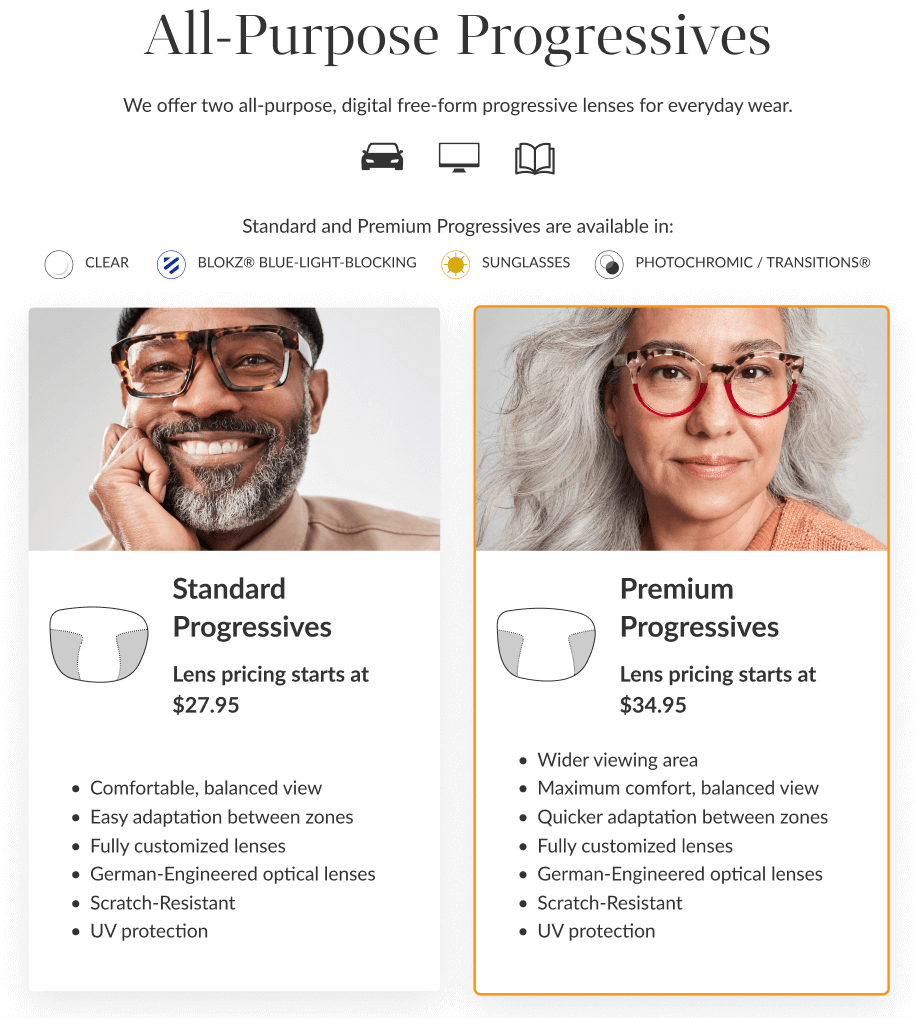
So, with all this advanced technology, are no line bifocals the perfect, one-size-fits-all solution? Like any sophisticated tool, they come with a unique set of characteristics. Understanding both the potential challenges and the significant benefits is key to deciding if they are the right choice for your vision needs.
Let's dive into a balanced look at what you can expect.
What Are the Disadvantages of No-Line Bifocals?
Being transparent about the adjustment process is important. While millions of people wear progressives comfortably every day, there are a couple of common hurdles new wearers might face.
Peripheral Distortion in Glasses: While greatly improved, some blurriness in the peripheral view can be a common issue for new wearers.
Have you ever heard someone mention a "swim" effect with new glasses? This can be caused by peripheral distortion in glasses. Because the lens power in no line bifocals is precisely blended from top to bottom, the outer edges of the lens can have some inherent blurriness. For a new wearer, turning your head quickly might make your peripheral vision feel slightly off.
The good news? Advanced free-form technology in 2025 lenses has dramatically reduced this effect, creating wider, clearer visual corridors. Most users find that after a short adaptation period, their brain learns to ignore these soft-focus areas completely.
The Initial Adjustment Period: There is a learning curve as your brain adapts to the different vision zones.
There is a definite learning curve when you first start wearing progressive lenses. Your brain needs time to instinctively learn where to look through the lens for different tasks—pointing your nose toward what you want to see clearly becomes the new norm.
Think of it like learning to use a new smartphone. At first, you might have to consciously think about where to tap, but soon it becomes second nature. Most people fully adapt within a few days to two weeks, after which the process of focusing becomes effortless.
The Clear Advantages Over Traditional Options
Despite the initial adjustment, the reasons for choosing no line bifocals are compelling. For most, the long-term benefits provide a level of convenience and visual quality that older lens types simply cannot match.
Progressive Lenses vs Traditional Lined Bifocals: Progressives offer a more natural visual experience without the abrupt image jump or distracting line of traditional bifocals.
The most obvious advantage of progressive lenses vs traditional lined bifocals is the absence of a dividing line. This isn't just a cosmetic plus; it eliminates the sudden "image jump" that occurs when your vision crosses the line in a traditional bifocal. This abrupt change can be disorienting and visually jarring.
With a progressive lens, the transition is seamless. Your focus moves smoothly from distance to near, mimicking natural vision far more effectively.
Single Vision vs Progressive Lenses: Unlike single vision glasses, progressives provide correction for multiple distances, eliminating the need to switch between pairs.
If you're currently juggling two pairs of glasses—one for distance and one for reading—you understand the frustration. Comparing single vision vs progressive lenses highlights the ultimate convenience of progressives. Instead of constantly swapping glasses to see your dashboard and then read a text message, you have one pair that does it all.
This all-in-one solution simplifies your life, providing clear, uninterrupted vision for every activity, from watching a movie to shopping for groceries. Understanding how these features can directly impact your visual freedom is the first step toward a more convenient life. To see the variety of frames and lens features that deliver these advantages, you can explore a curated collection of the latest no line bifocals.
【Investing in Your Vision: Cost and Considerations】
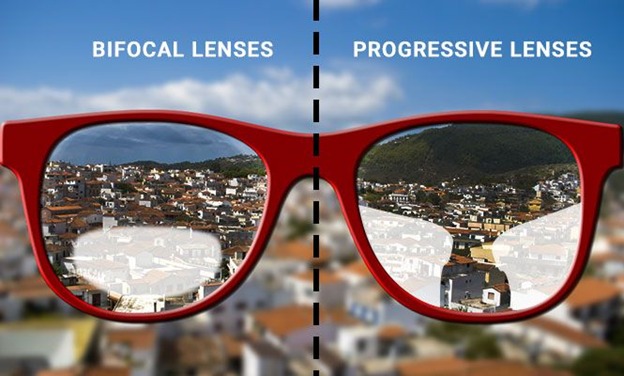
Making the switch to no-line bifocals is more than just a purchase; it's an investment in your daily visual comfort and quality of life. But what does that investment look like? The price of progressive lenses isn't arbitrary—it reflects the level of technology, customization, and materials used to create a lens tailored specifically to your eyes.
Understanding the factors that influence the final cost is key to making an informed decision that balances your budget with your visual needs for 2025.
How Much Do No-Line Bifocals Typically Cost?
One of the first questions on everyone's mind is, understandably, about the price. The cost can vary significantly based on the complexity and features of the lens.
Standard Progressive Lens Pricing: The cost for the lenses themselves often ranges from $145 to $290, depending on features.
For a high-quality, standard progressive lens, you can generally expect the cost for the lenses themselves to range from $145 to $290. This price point typically includes modern, digitally-surfaced lenses that provide clear vision and a smooth transition between distances. Factors influencing this price include the specific brand and any additional coatings you might choose, such as anti-reflective or scratch-resistant layers.
Specialized "Technology Lens" Pricing: For lenses optimized for computer work, expect a cost between $400 and $600.
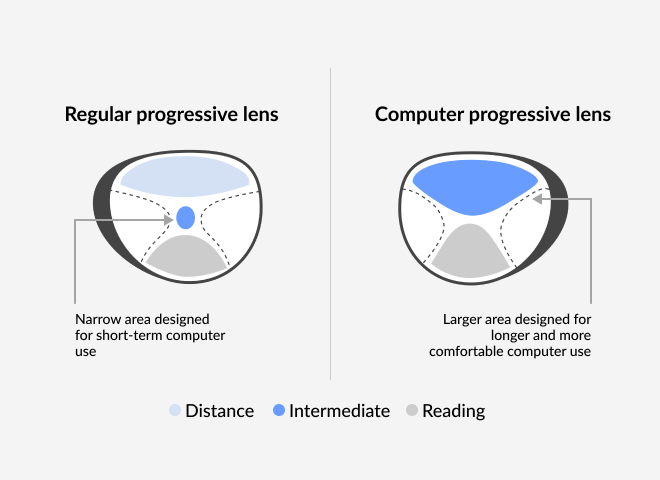
Do you spend hours a day in front of a computer? For lenses specifically engineered for extensive digital or office work, you might look at a "technology lens" with a cost between $400 and $600. These advanced lenses are optimized with wider intermediate (computer distance) and near (reading) zones to reduce digital eye strain and provide superior comfort for specific, prolonged tasks. The higher price reflects the sophisticated customization required.
Choosing the Right Pair: Frames and Materials
The performance of your no-line bifocals depends just as much on the frame and lens material as it does on the lens design itself. The right choices here will ensure you get the most out of your investment.
Advice from a Licensed Optician: It is recommended not to choose frames that are too small, as this can limit the effectiveness of the vision zones.
Here’s a crucial piece of advice directly from optical experts: it is recommended not to choose frames that are too small or short. Why? Progressive lenses require a certain vertical height to fit all three vision zones—distance, intermediate, and near—comfortably. A stylish but overly narrow frame can cut off the bottom of the reading area, severely limiting the effectiveness of your new lenses. Functionality should guide your fashion choice.
Exploring Polycarbonate Lens Benefits: This ultralight material offers enhanced durability and is often available as an upgrade.
When selecting a lens material, it’s worth exploring the benefits of polycarbonate lenses. This modern material is an excellent upgrade for several reasons. It is significantly lighter and thinner than standard plastic, making your glasses more comfortable for all-day wear. Furthermore, polycarbonate is exceptionally impact-resistant, offering enhanced durability and safety, a feature especially valuable for active individuals.
Understanding these cost factors and material options empowers you to build the perfect pair of glasses. Seeing how different frames work with advanced lens materials can help you visualize the final product and find what best suits your lifestyle and budget. To see a full range of compatible frames and compare lens options, check out these progressive-friendly glasses.
【Mastering Your New View: Adjustment & Special Uses】
Switching to progressive lenses opens up a world of seamless vision, but it also comes with questions. How do they work for specific tasks like long hours at a computer? And what about the infamous adjustment period? Let's demystify these common concerns so you can master your new eyewear with confidence.
Best No-Line Bifocals for Computer Work
If you spend a significant portion of your day staring at a screen, you're not just looking for general vision correction; you need a tool optimized for the digital world. Standard progressives are good, but specialized lenses are even better.
What are Technology Lenses?: A specialized progressive lens optimized for screen distance—typically 14 inches—to help with Vision Correction.
Have you heard of "technology lenses"? Think of them as a specialized type of progressive lens, meticulously engineered for your digital life. These lenses are optimized for the intermediate viewing distance—typically around 14 to 24 inches from your eyes—where your computer screen or tablet usually sits. This provides superior vision correction precisely where you need it most for office tasks.
Reducing Eye Strain from Screens: These Digital Eye Strain Glasses are designed to minimize uncomfortable head movements, alleviating neck and shoulder strain.
The primary benefit of these lenses is a significant reduction in digital eye strain. Often called Digital Eye Strain Glasses, they feature a much wider intermediate zone compared to standard progressives. This wider field of view means you can see your entire screen clearly without constant, uncomfortable head movements. The result? A more relaxed posture, which helps alleviate the neck and shoulder strain that often accompanies a long workday.
How to Adjust to No-Line Bifocals
The idea of "getting used to" new glasses can be intimidating, but the process is more straightforward than you might think, especially with today's advanced lens designs.
The Modern Adaptation Experience: Contemporary progressives are designed to be much easier to get used to compared to older versions.
Let's put one myth to rest: adapting to progressives in 2025 is not the challenge it once was. Modern, digitally-surfaced no-line bifocals are created with sophisticated technology that makes the transition between focal points smoother and more intuitive. Most wearers find that they adjust to no-line bifocals within a few days to a week of consistent use.
A Pro Tip for Adaptation: Train yourself to point your nose directly at your target and then tilt your chin up or down to find the clear focal point.
Here is the single most effective trick for a quick adaptation: Point your nose directly at whatever you want to look at. Instead of just moving your eyes, train yourself to move your whole head to aim your nose at your target. From there, simply tilt your chin up or down slightly to find the "sweet spot" in the lens that brings your target into perfect focus. This simple habit quickly teaches your brain how to navigate the different zones of the lens effortlessly.
Whether you need a specialized solution for screen time or are preparing for your first pair, understanding how these lenses function is key. Exploring the different lens designs available can help you choose a pair perfectly suited to your daily activities. To find the right pair that meets your visual demands, you can browse through a wide selection of no line bifocals.
【Your Path to Seamless Vision: Key Takeaways】
Transitioning to a new way of seeing can feel like a big step, but understanding the essentials of no line bifocals makes the journey clear and simple. These lenses, also known as progressives, represent the pinnacle of modern multifocal technology, engineered to provide a superior visual experience over outdated, lined options.
Here’s a summary of what makes them an excellent choice for correcting presbyopia:
* **Seamless, Natural Vision:** The primary advantage is the complete absence of lines. This eliminates the disorienting "image jump" of traditional bifocals, allowing your eyes to move smoothly between distance, intermediate, and near vision zones just as they would naturally.
* **All-in-One Convenience:** Say goodbye to juggling separate pairs of glasses for driving and reading. No line bifocals integrate multiple prescriptions into a single lens, offering you the ultimate convenience for every aspect of your daily life, from looking at a distant landscape to reading your phone.
* **Modern Aesthetic:** Without visible lines, these lenses offer a more youthful and clean appearance. They look just like single-vision glasses, so no one has to know you're wearing a multifocal lens.
* **Advanced Technology and Comfort:** While there is a short adjustment period, today's free-form digital surfacing technology has significantly minimized challenges like peripheral distortion. The result is a wider field of clear vision and a much quicker, more comfortable adaptation experience.
* **Smart Investment Choices:** Making an informed decision involves considering both frame and lens options. Opting for a frame with adequate vertical height and choosing advanced materials like lightweight, impact-resistant polycarbonate will maximize the performance and comfort of your new glasses.
Ultimately, choosing no line bifocals is an investment in your quality of life. They provide a sophisticated, comfortable, and aesthetically pleasing solution to the natural challenge of presbyopia, empowering you with clear and effortless vision for years to come.
``` MjAyNTA3MjYxMzI5MjI 当前显示MjAyNTA3MjYxMzI5MjI。

评论
发表评论